
Expansion Requirements for Roaster Machine of Baking Coated Peanuts and Coated Beans Production Line (Indonesia) | Processing Machinery & Turnkey Project Supply | TSHS
In the Indonesian snack food market, coated peanuts and coated legume-based nut products are typically manufactured through high-volume continuous production. However, in actual processing operations, manufacturers frequently encounter issues such as uneven heat distribution during roasting, insufficient throughput capacity, and inadequate equipment stability, all of which directly affect product texture and yield. In particular, coated nut materials are highly sensitive to roasting control; improper temperature or residence time management can easily result in scorching or inconsistent doneness. This customer case focuses on the practical challenges faced by an Indonesian food processing plant in the production of coated peanuts and coated legume nuts. By introducing suitable food machinery roasting and baking equipment, combined with stable thermal control and effective production line integration, the customer successfully improved overall production efficiency and established a more reliable and consistent mass production solution. A Expansion Requirements for Roaster Machine of Baking Coated Peanuts and Coated Beans Production Line (Indonesia) | food processing machinery manufacturer since 1965. CE certified food processing machinery including deep fryers, oil heating systems, seasoning tumblers, food liquid mixer machines, food liquid sprayer machines in snack foods industry. Food machine product list including: Continuous Automatic Frying Machine, Continuous Frying Machine Oil Heating System, Potato Chips Production Line, Grain Puff Production Line, Kurkure Production Line, Green Pea Production Line, Inflate (Pellet) Production Line, Nuts Processing Machine, Noodle Snack Production Line, Continuous Dryer Machine Conveyor- Automatic Type. Continuous Hot Air Dryer Machine, Customized dryer machine system, Dryer systems Solution for Consultation, Seasoning system, De-oiling system, Frying system peripheral equipment With more than 60 years experience to provide more than 500 fried production line all over the world. TSUNG HSING can provide the whole plant planning, improve the process and increase production quality and quantity. We also provide regular machine examination. Tsung Hsing is worth your trust.
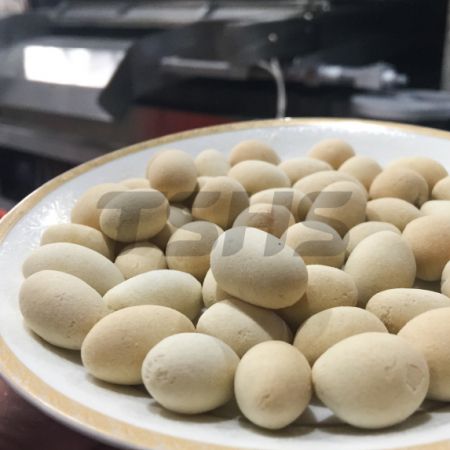
Expansion Requirements for Roaster Machine of Baking Coated Peanuts and Coated Beans Production Line (Indonesia)
Implementation Experience of Roasting Machines for Transitioning Coated Peanut and Coated Green Pea Production Lines from Capacity Bottlenecks to Stable Mass Production
In the Indonesian snack food market, coated peanuts and coated legume-based nut products are typically manufactured through high-volume continuous production. However, in actual processing operations, manufacturers frequently encounter issues such as uneven heat distribution during roasting, insufficient throughput capacity, and inadequate equipment stability, all of which directly affect product texture and yield. In particular, coated nut materials are highly sensitive to roasting control; improper temperature or residence time management can easily result in scorching or inconsistent doneness.
This customer case focuses on the practical challenges faced by an Indonesian food processing plant in the production of coated peanuts and coated legume nuts. By introducing suitable food machinery roasting and baking equipment, combined with stable thermal control and effective production line integration, the customer successfully improved overall production efficiency and established a more reliable and consistent mass production solution.
Why Is It Necessary to Re-evaluate Processing Equipment for Coated Nuts and Legumes?
The customer is a large-scale food and beverage manufacturer in Indonesia with vertically integrated operations, encompassing peanut cultivation, raw material processing, and product distribution. With full control over the supply chain, the company maintains strong competitiveness in the international snack food market and is recognized as one of Indonesia's leading food manufacturers. The customer has long specialized in nuts and snack products, with coated peanuts and coated green peas serving as core product lines that consistently perform well in the market. As market demand has continued to grow year by year, the existing production lines have gradually come under capacity pressure. Although multiple baking roaster machine–type machines were already installed at the customer's facility, prolonged continuous operation revealed limitations in both actual output and operational stability. These constraints were no longer sufficient to support future capacity expansion plans, prompting the customer to re-evaluate and identify a more suitable equipment solution for long-term, stable production.

Limitations of Existing Equipment Restrict Further Production Line Expansion
In the past, the customer had collaborated with Japanese equipment suppliers; however, under actual mass production conditions, the equipment's throughput performance and operational stability did not fully meet expectations. As order volumes increased, process-related issues became more pronounced, affecting production planning and significantly increasing on-site management pressure. Therefore, when planning the next phase of production line upgrades, the customer sought food processing machinery that would be better suited for high-volume manufacturing and capable of long-term, stable operation. In particular, for the heating and roasting processes of coated nuts and legumes, equipment stability is a critical factor that directly impacts final product quality.

Building Trust in a New Supplier Through a Search-Driven Evaluation Process
During the evaluation phase, the customer began by searching online for information related to Baking Roaster Machines and nut processing food machinery, which led them to TsungHsing(TSHS). At the initial stage, the customer maintained a cautious attitude toward a new equipment supplier and raised numerous questions regarding production capacity, operational stability, and practical applicability under real production conditions. Throughout multiple rounds of communication, the TsungHsing(TSHS) team did not rely solely on theoretical explanations. Instead, they provided actual testing results and clear technical clarification, allowing the customer to gradually verify the feasibility of the equipment for coated peanut and coated green pea processing. This data-driven, test-based communication approach became a key factor in building trust and ultimately convinced the customer to proceed with the cooperation.

Equipment Adjustments Based on Raw Material Characteristics
During the equipment planning stage, the customer specifically highlighted the smaller size of the raw materials. In response, the TsungHsing (TSHS) team modified the discharge outlet design of the Baking Roaster Machine to ensure that products would not be lost during tumbling and heating, thereby improving overall process stability. In addition, since the customer's facility uses LNG gas as its energy source, the equipment's burner nozzle configuration and combustion conditions were optimized based on actual trial operation results. This ensured that heating efficiency was fully aligned with on-site operating conditions. These detailed adjustments allowed the equipment to be seamlessly integrated into the customer's existing production process, rather than simply applying a standardized machine configuration.

Actual Improvements in Capacity and Operational Stability After Production Start-Up
After the Baking Roaster Machine was officially commissioned on the production line, the customer experienced a clear improvement in throughput performance. Actual test results indicated an output of approximately 180 kg per hour, while maintaining good operational stability under continuous running conditions, making the process easier to control. Compared with the previous equipment, the newly installed Baking Roaster Machine enabled on-site operators to manage temperature control and operation more smoothly. It also reduced production disruptions caused by equipment instability, delivering tangible improvements to overall production line efficiency.

Building Long-Term Partnership Confidence from Commissioning to After-Sales Support
Prior to shipment, TsungHsing (TSHS) conducted testing using the customer's actual raw materials to ensure that the equipment condition met mass production requirements. After the delivery of the first unit, internal reviews and process adjustments were carried out based on the customer's feedback, enabling a smoother commissioning process for the second Baking Roaster Machine. During operation, whenever component wear occurred, the TsungHsing (TSHS) team responded promptly and completed replacement and maintenance work efficiently. This level of after-sales support left a strong impression on the customer regarding service reliability and further reinforced their confidence in applying the equipment across additional production lines.

Expanding Cooperation from Baking Roaster Machines to Broader Production Line Planning
In the past, the customer's frying equipment was primarily supplied by U.S. manufacturers, while nut processing lines relied on Japanese machinery. Through this cooperation involving the Baking Roaster Machine, the customer developed trust in TsungHsing (TSHS) based on its performance in food machinery design, actual operating results, and after-sales support. As a result, the customer has begun further discussions regarding frying and processing equipment for pellet-based extruded snack products. For the customer, an equipment supplier is not merely a machine provider, but a long-term partner capable of delivering continuous support throughout the growth and expansion of production lines.

Voices from Our Customers
“After introducing the new Baking Roaster Machine, we clearly experienced improvements in production line stability and operational efficiency. The equipment runs smoothly during the heating process for coated peanuts and coated green peas, achieving an output of approximately 180 kg per hour, which is highly beneficial for our long-duration continuous production requirements.
From initial discussions and trial runs to actual production start-up, TsungHsing (TSHS) was able to adjust the equipment according to our raw materials and on-site conditions, including discharge structure design and energy configuration. This ensured that the machine truly fit our production process. The overall user experience and after-sales support have given us strong confidence, and we feel reassured about sourcing additional food processing lines from TsungHsing (TSHS).”—— Owner, Indonesian Coated Nut and Legume Manufacturer
- Videos
FRYIN-201 Small-size Continuous Fryer
Enter the continuous production market at an affordable price. The "small volume, space-saving" FRYIN-201 fryer. Suitable for small food industry, central kitchens, restaurants, food stores, schools, etc.
 Download
 Hot Products

Over 50 Years of Expansion Requirements for Roaster Machine of Baking Coated Peanuts and Coated Beans Production Line (Indonesia) Supply | TSHS
Based in Taiwan, since 1965, TSUNG HSING FOOD MACHINERY CO., LTD. is a Expansion Requirements for Roaster Machine of Baking Coated Peanuts and Coated Beans Production Line (Indonesia) supplier in snack foods industry.
500 food processing production lines sold in 65 countries, TSHS is a food machine expert with over 60 years of experiences. CE certified, reasonably priced food processing machinery are industrial fryers, oil heating systems, seasoning tumblers, liquid mixer machines, liquid sprayer machines, etc.
TSHS has been offering customers high-quality food processing machines for green peas, nuts, potato chips, grain puffs and corn puffs, with total snack foods solutions. They represent trust, specialty, high-quality and safety specialization, which is where their name TSHS came from.