
Kumeta Dryer Manufacturer Seeking OEM Machinery Manufacturing Partnership (Japan) | Processing Machinery & Turnkey Project Supply | TSHS
Facing long-term labor shortages in Japan's manufacturing sector and continuously rising equipment quality requirements, an increasing number of Japanese drying equipment manufacturers are seeking overseas OEM machinery manufacturing partners with complete machine fabrication capabilities. In this case, the Japanese customer faced growing challenges in internal production scheduling and delivery management due to a continuous increase in orders, and therefore chose to cooperate with TsungHsing (TSHS) in Taiwan to undertake OEM manufacturing of a Multi-Layers Industrial Dryer. From drawing confirmation, machining detail discussions, and dimensional control to three-stage inspection and acceptance, both parties completed the equipment delivery through stable collaboration, further establishing the foundation for future repeat orders. A Kumeta Dryer Manufacturer Seeking OEM Machinery Manufacturing Partnership (Japan) | food processing machinery manufacturer since 1965. CE certified food processing machinery including deep fryers, oil heating systems, seasoning tumblers, food liquid mixer machines, food liquid sprayer machines in snack foods industry. Food machine product list including: Continuous Automatic Frying Machine, Continuous Frying Machine Oil Heating System, Potato Chips Production Line, Grain Puff Production Line, Kurkure Production Line, Green Pea Production Line, Inflate (Pellet) Production Line, Nuts Processing Machine, Noodle Snack Production Line, Continuous Dryer Machine Conveyor- Automatic Type. Continuous Hot Air Dryer Machine, Customized dryer machine system, Dryer systems Solution for Consultation, Seasoning system, De-oiling system, Frying system peripheral equipment With more than 60 years experience to provide more than 500 fried production line all over the world. TSUNG HSING can provide the whole plant planning, improve the process and increase production quality and quantity. We also provide regular machine examination. Tsung Hsing is worth your trust.
Kumeta Dryer Manufacturer Seeking OEM Machinery Manufacturing Partnership (Japan)
Japanese Kumeta Dryer Manufacturer and TsungHsing (TSHS) Established an OEM Machinery Manufacturing Partnership to Complete a Multi-Layers Industrial Dryer Production Project.
Facing long-term labor shortages in Japan's manufacturing sector and continuously rising equipment quality requirements, an increasing number of Japanese drying equipment manufacturers are seeking overseas OEM machinery manufacturing partners with complete machine fabrication capabilities. In this case, the Japanese customer faced growing challenges in internal production scheduling and delivery management due to a continuous increase in orders, and therefore chose to cooperate with TsungHsing (TSHS) in Taiwan to undertake OEM manufacturing of a Multi-Layers Industrial Dryer.
From drawing confirmation, machining detail discussions, and dimensional control to three-stage inspection and acceptance, both parties completed the equipment delivery through stable collaboration, further establishing the foundation for future repeat orders.
Customer Background
In Japan's equipment manufacturing industry, dryer fabrication is not simply a matter of machining according to drawings; it also involves dimensional accuracy, structural integration, process stability, and delivery schedule control. For Japanese manufacturers facing long-term labor shortages, identifying OEM partners with complete machinery manufacturing capabilities has become an important direction in supply chain restructuring within the equipment industry.
The Japanese customer in this project is a long-established dryer manufacturer specializing in equipment such as cylindrical agitator dryers, Multi-Layers Industrial Dryers, and rotary drying systems. Its equipment is widely applied in food processing, agricultural product handling, and industrial material drying. After years of market development, the customer began seeking a reliable Asian OEM manufacturing partner for long-term cooperation, and ultimately established collaboration with TsungHsing (TSHS) in Taiwan.
From FOOMA Trade Show Contact to Official OEM Project Launch Three Years Later
The initial contact between both parties began at the FOOMA JAPAN food machinery exhibition in Japan. As labor shortages in Japan’s manufacturing sector have become increasingly severe in recent years, the customer actively began searching for manufacturing partners with proven food equipment fabrication experience. During the first two years, both parties mainly built familiarity through exhibition meetings, with the customer repeatedly visiting the TsungHsing (TSHS) booth to understand equipment manufacturing details.
In the third year, after TsungHsing (TSHS) brought an actual machine unit for on-site display, the customer began a more in-depth evaluation of equipment structure, welding quality, and overall finishing standards, leaving a strong impression of the machine shown at the exhibition. After the exhibition, both sides arranged factory visits. The Japanese customer visited Taiwan to observe the manufacturing process directly and held further technical discussions regarding drying equipment. Following multiple rounds of confirmation and technical review, the first OEM equipment manufacturing project was officially launched in 2025.

Why Chose TSHS in Taiwan Instead of Local Fabrication Workshops
For the Japanese customer, the issue was not a lack of local machining resources. However, most local subcontractors were only able to complete partial structural work, such as individual frames, single panels, or specific mechanical sections. When equipment is fabricated in separate stages by multiple suppliers, dimensional deviations, interface inconsistencies, and structural alignment problems often emerge during final assembly, even when all parts are produced according to drawings.
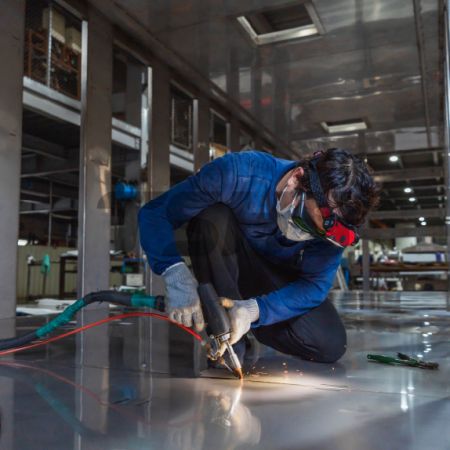
The advantage of TsungHsing (TSHS) lies in the ability to complete full machine integration within a single manufacturing team. From material processing, structural welding, and frame assembly to final machine completion, all manufacturing details can be adjusted within one coordinated process. This significantly reduces cumulative errors and ensures higher equipment stability after delivery. This integrated manufacturing capability became one of the key reasons why the Japanese customer selected TsungHsing (TSHS) for OEM dryer production after evaluation.

OEM Manufacturing Scope: Multi-Layers Industrial Dryer Production
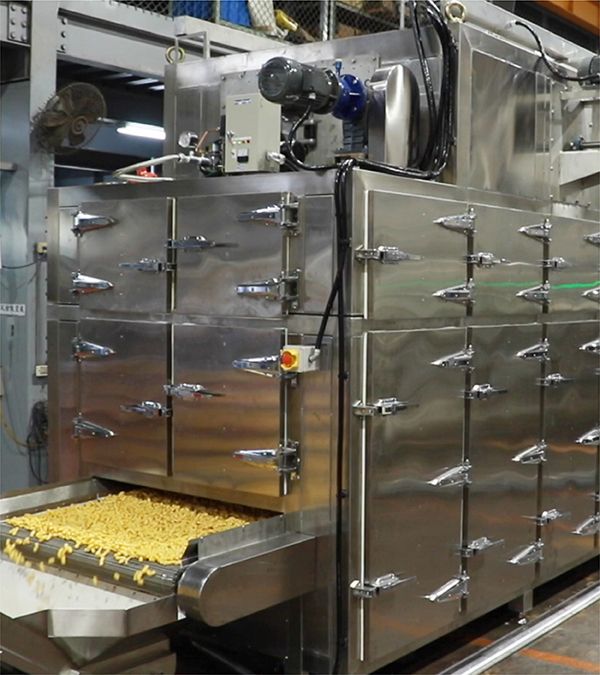
In this project, the primary equipment commissioned by the customer was a Multi-Layers Industrial Dryer. The manufacturing complexity of this type of dryer lies in heat source configuration, frame structure, internal heat distribution uniformity, and overall dimensional accuracy. In particular, when the equipment is required to meet Japanese market quality standards, not only must structural dimensions be precise, but exterior finishing details and cleanliness standards are also subject to strict evaluation.
During the manufacturing process, the customer first provided the design drawings, after which the TsungHsing (TSHS) team conducted detailed drawing verification. Specific items such as hole positions, bolt specifications, plate cutting details, welding methods, and door orientation were discussed one by one. Whenever unclear points were identified in the drawings, both parties used online meetings to confirm details in advance, preventing deviations during actual fabrication.

Completed Within Three Months: Delivery Pressure and Production Coordination
For the Japanese customer, delivery requirements were clearly defined, with the expectation that the complete equipment set be finished within three months. Such a delivery timeline is highly demanding in machinery manufacturing, especially for drying equipment involving extensive sheet metal fabrication, welding, and assembly work. Through internal schedule integration, laser cutting, bending, and structural assembly processes were planned in advance, allowing the overall manufacturing rhythm to remain stable and enabling delivery within the customer’s required timeframe.
In addition to machine fabrication, shipping arrangements from Taiwan to Japan also had to be considered simultaneously, including container loading, customs clearance, and local logistics in Japan. Since total transportation time typically requires an additional two to three weeks, manufacturing time had to be compressed in advance to ensure on-schedule shipment.

Japanese Inspection Standards Were More Detailed Than Expected
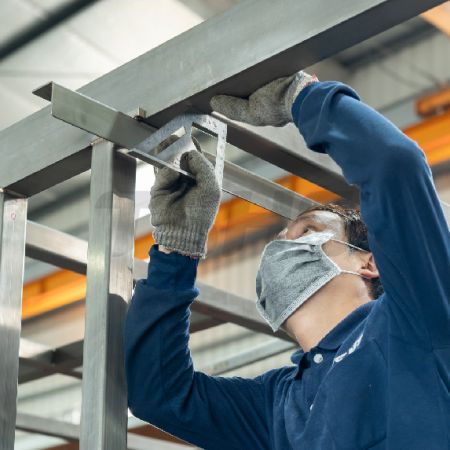
During the inspection phase, the Japanese customer visited Taiwan three times to examine the equipment. The first visit focused on raw material quality verification, the second on frame dimensions and structural verticality, and the third on final inspection of the complete machine. The customer brought precision measuring tools, including a level gauge, to conduct on-site inspection and verify frame straightness and dimensional accuracy. In addition, special attention was given to whether material surfaces contained scratches, whether weld areas had been fully cleaned, whether labels had been completely removed, and whether laser cutting marks on material surfaces had been properly treated.
While these points may often be regarded as secondary details in general equipment manufacturing, for Japanese machinery customers they directly reflect equipment completion quality and brand standards. As a result of this project, we further optimized internal cleaning procedures and raised surface finishing standards for future equipment manufacturing.

Immediate Follow-Up Order After Completion of the First Unit
After the first equipment set was completed and successfully delivered, the customer did not raise any major abnormalities or request significant post-delivery corrections. The machine operated stably after installation in Japan. More importantly, shortly after completion of the first project, the customer placed an order for a second dryer of the same type. This indicates that the cooperation was not limited to a single project, but marked the beginning of a sustainable and trusted OEM manufacturing partnership between both parties.

It Was Validation of Manufacturing Capability for the Japanese Market
The Japanese market has long represented a benchmark for high equipment quality standards. Successfully passing inspection by a Japanese manufacturer and subsequently receiving repeat orders demonstrates not only delivery capability, but also real market validation of overall manufacturing processes, dimensional control, and machine integration capability. This is fully aligned with the long-term manufacturing direction of TsungHsing (TSHS): from drawing interpretation, 3D drafting, and process integration to final machine completion, every manufacturing detail must correspond to actual end-use requirements. This OEM cooperation model with Japan closely matches the manufacturing logic and quality standards that TsungHsing (TSHS) has developed over many years.
Stable Manufacturing Quality Is the Key to Long-Term Cooperation
For the Japanese customer, when working with an overseas machinery OEM manufacturer for the first time, the primary concern was not only whether the equipment could be built according to drawings, but also whether the overall cooperation process would remain stable, whether details could be properly understood, and whether delivery schedules would be predictable. In this project, the customer noted that TsungHsing (TSHS) was able to quickly understand design requirements during the drawing confirmation stage and proactively clarify manufacturing details, allowing many issues that might otherwise have appeared during later assembly to be resolved before production began. In particular, overall performance met expectations in equipment frame integration, dimensional control, and structural completion quality.
The customer also mentioned that although the Japanese market places particularly high demands on surface finishing details and cleanliness, TsungHsing (TSHS) responded quickly after each inspection and discussion by adjusting manufacturing details, demonstrating strong cooperation and improvement efficiency. After completion of the first unit, the equipment operated stably after installation, which led the customer to decide within a short period to proceed with a second equipment order.
For the customer, a reliable long-term OEM manufacturing partner is not simply a supplier capable of completing equipment, but one that can maintain communication efficiency throughout manufacturing, understand quality requirements, and sustain a stable pace in international cooperation. This is also the key reason why both parties continue to deepen cooperation after the first project.

Voices from Our Customers
“TsungHsing (TSHS) maintained a highly stable level of cooperation throughout the drawing confirmation and manufacturing process, and was able to respond to and adjust detail-related issues in a timely manner. After completion, the equipment generally met our original requirements in terms of dimensional accuracy, structural integration, and overall quality. The detailed points raised during inspection were also addressed through subsequent improvements. For us, maintaining effective communication and stable manufacturing quality is the essential foundation for continued cooperation.”—— General Manager, Major Japanese Drying Equipment Manufacturer
- Related Products
-
OEM Dryer Manufacturing Services for the Japanese Market
Tsung Hsing(TSHS) specializes in the manufacturing of food processing machinery and has established...
Details - Videos
FRYIN-201 Small-size Continuous Fryer
Enter the continuous production market at an affordable price. The "small volume, space-saving" FRYIN-201 fryer. Suitable for small food industry, central kitchens, restaurants, food stores, schools, etc.
 Download
 Hot Products

Over 50 Years of Kumeta Dryer Manufacturer Seeking OEM Machinery Manufacturing Partnership (Japan) Supply | TSHS
Based in Taiwan, since 1965, TSUNG HSING FOOD MACHINERY CO., LTD. is a Kumeta Dryer Manufacturer Seeking OEM Machinery Manufacturing Partnership (Japan) supplier in snack foods industry.
500 food processing production lines sold in 65 countries, TSHS is a food machine expert with over 60 years of experiences. CE certified, reasonably priced food processing machinery are industrial fryers, oil heating systems, seasoning tumblers, liquid mixer machines, liquid sprayer machines, etc.
TSHS has been offering customers high-quality food processing machines for green peas, nuts, potato chips, grain puffs and corn puffs, with total snack foods solutions. They represent trust, specialty, high-quality and safety specialization, which is where their name TSHS came from.