
Food Processing Energy Systems Explained: How Different Heating Technologies Affect Production Efficiency? | TSHS News and Events | TSUNG HSING FOOD MACHINERY CO., LTD.
TSHS Food Processing Energy Systems Explained: How Different Heating Technologies Affect Production Efficiency?. TSHS is a professional food machine manufacturer. We have exclusive patented heating system. Provided more than 500 frying production around the world. Also offer customized microwave industrial dryer.. We are a professional frying machine manufacturer. And provide customized continuous automatic drying equipment services. Our customer includes the top 10 snack food companies in various countries, central kitchen, other fried food manufacturers, Food Industry/Biotechnology Industry/Chemical Industry/Rubber Industry/Textile Industry. that have a need for the drying system. We have 60 years of professional food equipment manufacturing experience, specialized in food frying production equipment, customized continuous drying systems, extruder equipment, seasoning systems, de-oiling equipment. We provide global installation services, entire factory planning consultation, production knowledge guidance, improve the process problems, and provide after-services of maintaining inspection for equipment. TSHS equipment is always your best choice.
Food Processing Energy Systems Explained: How Different Heating Technologies Affect Production Efficiency?
In food processing production lines, whether for frying, drying, baking, or various thermal treatment applications, the core principle is the transfer of heat energy to materials. The choice of energy source is often one of the key factors affecting production efficiency and product quality consistency.
Different energy systems influence not only heating speed, but also temperature stability and overall energy utilization. Some energy sources are better suited for rapid heating and high-capacity production, while others prioritize temperature uniformity and stability. Therefore, understanding the characteristics and applications of different energy systems is essential when planning food processing equipment and production lines.
Common Energy Sources and Heating Technologies in Food Processing
Common energy sources used in food processing include electricity, gas (natural gas or LPG), diesel, steam systems, and thermal oil systems. In addition, infrared and microwave technologies are increasingly being adopted as advanced heating solutions to improve process efficiency and optimize production performance. Rather than serving as direct substitutes for one another, these energy systems are typically integrated and combined based on product characteristics, process requirements, and factory conditions.
Electrical Systems: The Foundation of Stable and Precise Heating Control
Electricity is one of the most widely used energy sources in food processing equipment and is commonly applied in conveying, mixing, frying, drying, and automation control systems. In heating applications, electrical systems offer significant advantages in terms of stability and precise temperature control. Through electric heating elements, electrical energy can be directly converted into heat, allowing process conditions to remain highly stable. This makes electrical heating particularly suitable for applications that require high product consistency, such as baking and precision drying.
In addition, electrical systems do not involve combustion processes, meaning there are no combustion emissions. This simplifies environmental management and food safety compliance while making it easier to meet international regulations. However, for large-scale production lines, high-power electrical equipment may require substantial power capacity, making infrastructure investment and energy costs important considerations.
Gas and Diesel: High Heat Output Combustion Energy Sources
Gas and diesel are combustion-based energy sources that provide strong heat output and are commonly used in processes requiring rapid heating or high-temperature operation. Gas systems, including natural gas and LPG, are widely used in food processing due to their fast heating capability and operational flexibility. They are particularly suitable for frying equipment and various thermal processing applications. Natural gas burns relatively cleanly and remains one of the most mature and commonly adopted energy options in the industry. However, because combustion is involved, proper exhaust systems and gas safety piping are essential to ensure safe operation.
Diesel is more commonly used in large industrial applications or environments where energy supply conditions are limited. Its advantages include flexible fuel storage and stable long-term operation. However, diesel systems generally produce higher emissions and require more complex equipment maintenance. As a result, diesel is often used as a supplementary or alternative energy source in modern food processing facilities.

Steam and Thermal Oil Systems: Core Heat Sources for Large-Scale Production Lines
In larger food manufacturing facilities, steam and thermal oil systems often serve as centralized heating infrastructures, supporting multiple processing units through a unified heat supply system. Steam systems generate steam through boilers and distribute it through pipelines for heat exchange applications. During condensation, steam releases a large amount of latent heat, improving both heating efficiency and process stability. This makes steam particularly suitable for sterilization, cooking, and drying applications.
Thermal oil systems use circulation pumps to transfer high-temperature thermal oil through equipment for indirect heating. Compared to steam systems, thermal oil can achieve higher operating temperatures under non-pressurized conditions. With proper system design, thermal oil systems can provide stable and uniform temperature control, making them especially suitable for frying, baking, and continuous production processes. Both systems share the characteristics of indirect heating and centralized heat management, helping improve temperature stability and overall energy efficiency across large-scale production lines.

Infrared Heating: High-Efficiency Radiant Heat Transfer Technology
Infrared heating is not an energy source itself, but rather a heat transfer method that typically uses electricity as its energy input. The principle involves transferring heat directly to the material surface through infrared radiation, reducing reliance on air or medium conduction. This heating method offers advantages such as rapid thermal response and improved energy utilization efficiency, effectively reducing heat loss during transfer. Because the heat is applied directly to the product surface, infrared heating can also minimize localized overheating and uneven heating issues. In drying and surface treatment applications, infrared technology has increasingly become an important solution for improving process efficiency.

Microwave Heating: Rapid Internal Heating Technology
Microwave heating uses electromagnetic waves to cause water molecules inside food products to vibrate and generate heat. Unlike conventional external heating methods, microwaves can penetrate materials directly, rapidly increasing internal temperatures. This “inside-out” heating characteristic provides significant advantages in applications requiring rapid processing or shorter production times, such as drying, thawing, and pre-treatment processes. In practical applications, microwave systems are often combined with other heating methods to balance heating uniformity and product quality.

Food Processing Energy Comparison: Key Differences Between Heating Systems

How to Choose the Right Energy System for Food Processing?
In practical applications, there is no single standard solution for energy configuration. Different product characteristics, production capacities, and factory conditions all influence the final energy selection strategy. During the planning stage, factors such as electrical capacity, boiler availability, product characteristics (including moisture content and heat sensitivity), target production capacity, and future expansion requirements should all be carefully evaluated. Through comprehensive analysis, manufacturers can establish the most suitable energy configuration strategy for their production needs.
When assisting customers with production line planning, we evaluate actual processing requirements alongside equipment experience and testing data to assess the feasibility and long-term benefits of different energy solutions. If you are currently evaluating food processing equipment or planning a new production line, clarifying your energy configuration strategy early and validating it through practical testing can help reduce future modification costs while ensuring stable and efficient production performance.
Hot Products
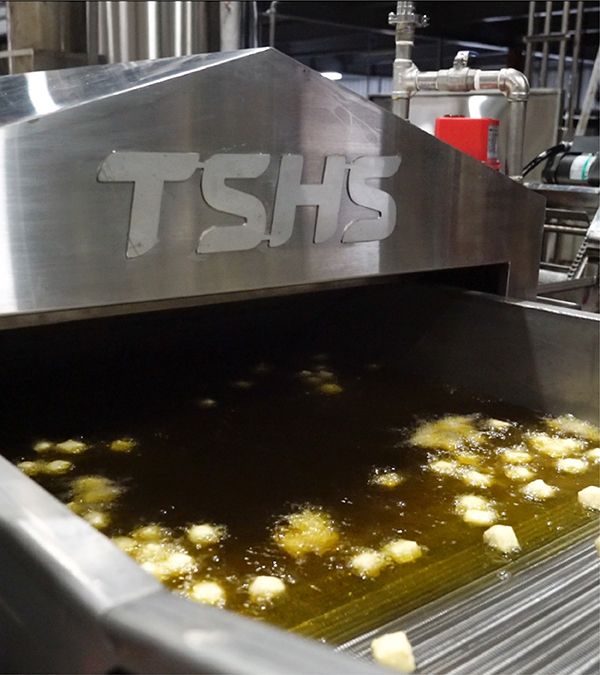
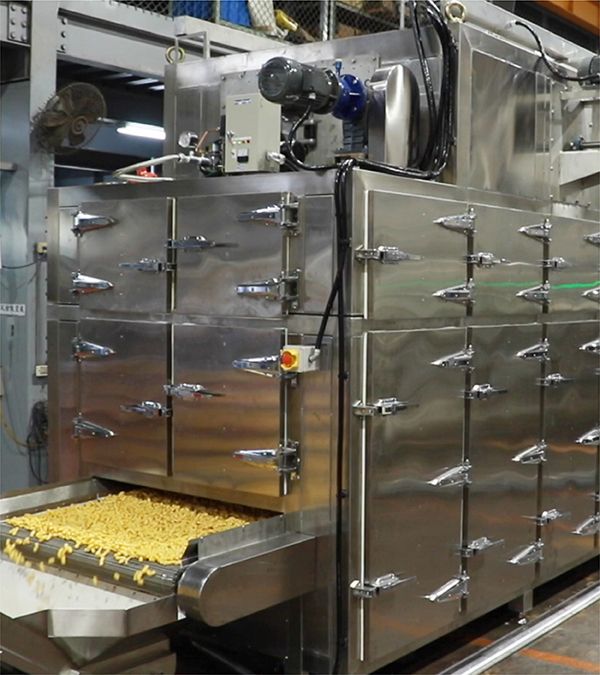
FRYIN-201 Small-size Continuous Fryer
Enter the continuous production market at an affordable price. The "small volume, space-saving" FRYIN-201 fryer. Suitable for small food industry, central kitchens, restaurants, food stores, schools, etc.
 Download
 Over 50 Years of Deep Fryer Machine | Snack Food Processing Equipment & Turnkey Project Supply | TSHS
Based in Taiwan, since 1965, TSUNG HSING FOOD MACHINERY CO., LTD. is a food processing equipment supplier in snack foods industry.
500 food processing production lines sold in 65 countries, TSHS is a food machine expert with over 60 years of experiences. CE certified, reasonably priced food processing machinery are industrial fryers, oil heating systems, seasoning tumblers, liquid mixer machines, liquid sprayer machines, etc.
TSHS has been offering customers high-quality food processing machines for green peas, nuts, potato chips, grain puffs and corn puffs, with total snack foods solutions. They represent trust, specialty, high-quality and safety specialization, which is where their name TSHS came from.