
Fried Pork Rinds Machine And Equipment Supplier | Processing Machinery & Turnkey Project Supply | TSHS
The key to fried pork rinds production lies not only in frying but also in the coordinated control of the entire manufacturing process. From pork skin pretreatment, drying, frying and puffing, and de-oiling to seasoning, every processing stage directly affects the final product's crispiness, expansion ratio, oil content, and consistency in appearance. Therefore, equipment configuration should not be viewed as the purchase of individual machines but should be planned with a focus on the stability and continuity of the entire production process. A Fried Pork Rinds Machine And Equipment Supplier | food processing machinery manufacturer since 1965. CE certified food processing machinery including deep fryers, oil heating systems, seasoning tumblers, food liquid mixer machines, food liquid sprayer machines in snack foods industry. Food machine product list including: Continuous Automatic Frying Machine, Continuous Frying Machine Oil Heating System, Potato Chips Production Line, Grain Puff Production Line, Kurkure Production Line, Green Pea Production Line, Inflate (Pellet) Production Line, Nuts Processing Machine, Noodle Snack Production Line, Continuous Dryer Machine Conveyor- Automatic Type. Continuous Hot Air Dryer Machine, Customized dryer machine system, Dryer systems Solution for Consultation, Seasoning system, De-oiling system, Frying system peripheral equipment With more than 60 years experience to provide more than 500 fried production line all over the world. TSUNG HSING can provide the whole plant planning, improve the process and increase production quality and quantity. We also provide regular machine examination. Tsung Hsing is worth your trust.
Fried Pork Rinds Machine And Equipment Supplier
Pork Rinds Fryer Machine
Fried Pork Rinds Fryer Machine
The key to fried pork rinds production lies not only in frying but also in the coordinated control of the entire manufacturing process. From pork skin pretreatment, drying, frying and puffing, and de-oiling to seasoning, every processing stage directly affects the final product's crispiness, expansion ratio, oil content, and consistency in appearance. Therefore, equipment configuration should not be viewed as the purchase of individual machines but should be planned with a focus on the stability and continuity of the entire production process.
Based on the requirements of different markets and the characteristics of products such as Chicharon in the Philippines, Kaeb Moo in Thailand, and Pork Scratchings in the United Kingdom, Tsung Hsing (TSHS) helps food manufacturers plan suitable cooking processes, frying conditions, frying oil management, and downstream seasoning equipment configurations to maintain consistent product quality and high production efficiency across different product types.
Fried Pork Rinks Solution
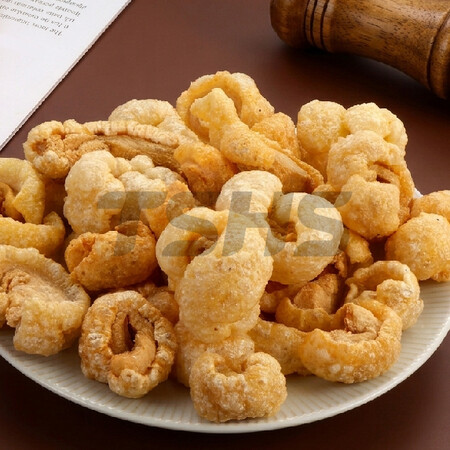
Fried pork rinds is a popular fried snack and traditional food enjoyed worldwide, with steady market demand in the Philippines, Thailand, and the United Kingdom. Depending on regional preferences and product positioning, fried pork rinds can be processed into various products, including puffed Pork Rinds, thick-cut Cracklins, British-style Pork Scratchings, and Thai-style Kaeb Moo. Despite their differences, these products share several key processing stages, including pork skin pretreatment, defatting, cooking, drying (dehydration), frying and puffing, de-oiling, seasoning, and packaging.
Due to variations in pork skin thickness, fat content, and moisture levels, inadequate control during the initial processing stages can lead to quality issues such as insufficient puffing, inconsistent product hardness, excessive oil absorption, uneven surface blistering, and inconsistent color. In addition, fried pork rinds production generates significant amounts of frying residues and collagen deposits. Without effective frying oil management and filtration, oil deterioration can accelerate, increasing cleaning frequency and negatively affecting product flavor, shelf life, and production efficiency.
Therefore, establishing a stable and continuously operating fried pork rinds production line is essential for food manufacturers seeking to improve product consistency, reduce production costs, and expand production capacity.
Common Manufacturing Challenges in Fried Pork Rinds Production
● Variations in Pork Skin Thickness and Fat Content
Pork skin from different parts of the animal varies significantly in thickness, collagen content, and residual fat levels. Without proper pretreatment and grading, these variations can lead to inconsistent puffing during frying, affecting product appearance, crispiness, and overall production yield.
● Inconsistent Moisture Control Affecting Puffing Performance
The puffing performance of fried pork rinds is highly dependent on its moisture content before frying. Insufficient drying can result in poor expansion and a hard texture, while excessive drying may cause bursting, breakage, or overly dark coloration. Therefore, maintaining stable and uniform moisture control throughout the drying process is essential for consistent product quality.
● Difficulties in Controlling Frying Temperature and Residence Time
Pork skin requires rapid dehydration and uniform puffing during high-temperature frying. Fluctuations in frying oil temperature or inconsistent conveyor speeds can result in incomplete puffing, localized burning, or uneven coloration, ultimately affecting product quality and market acceptance.
● Frying Residues and Collagen Deposits Accelerating Oil Deterioration
Fried pork rinds production releases significant amounts of fat, proteins, and fine collagen residues into the frying oil. Without continuous oil filtration, these residues can accelerate oil oxidation, carbonization, and the development of undesirable odors. This not only increases oil replacement costs but also affects product color, flavor, and food safety.
● Uneven Seasoning Affecting Product Consistency
Fried pork rinds products are commonly available in various flavors, including BBQ, Hot & Spicy, Salt & Vinegar, Cheese, Garlic, and regional specialty seasonings. Insufficient mixing efficiency in seasoning equipment can result in uneven seasoning distribution, inconsistent flavors, and poor seasoning adhesion, affecting overall product consistency and brand quality.
● Challenges in Integrating High-Capacity Continuous Production Lines
As market demand continues to grow in the Philippines, Thailand, and other regions worldwide, traditional batch production methods are becoming less capable of meeting large-volume orders. Integrating drying, frying, de-oiling, seasoning, and conveying processes while reducing manual intervention and increasing production line automation has become a key challenge for food manufacturers.
Recommended Equipment for Fried Pork Rinds Frying Line
Cooking
Other Processes
Blanching Equipment
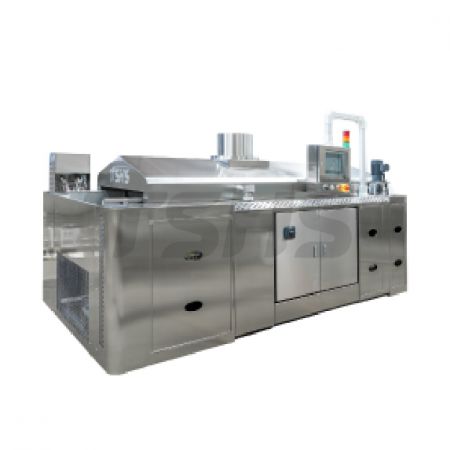
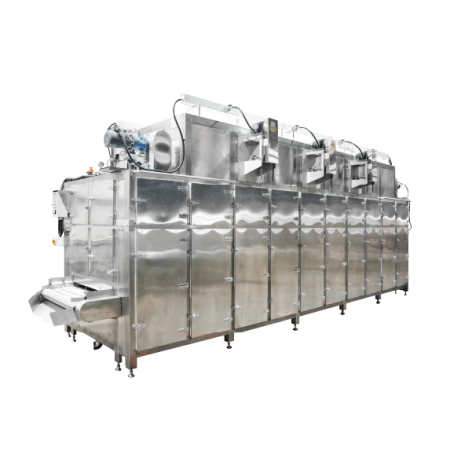
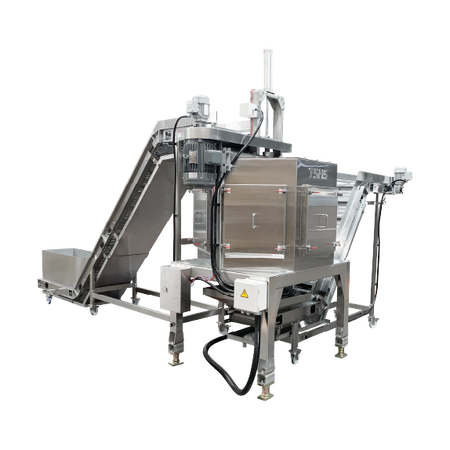
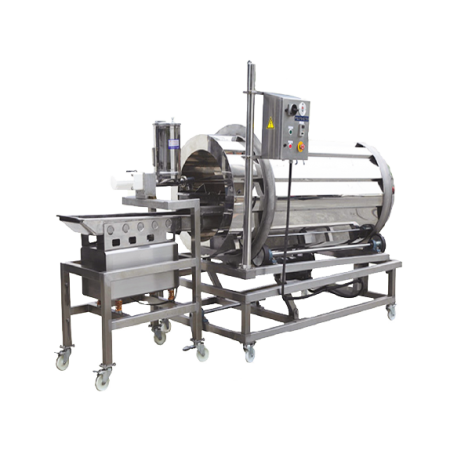
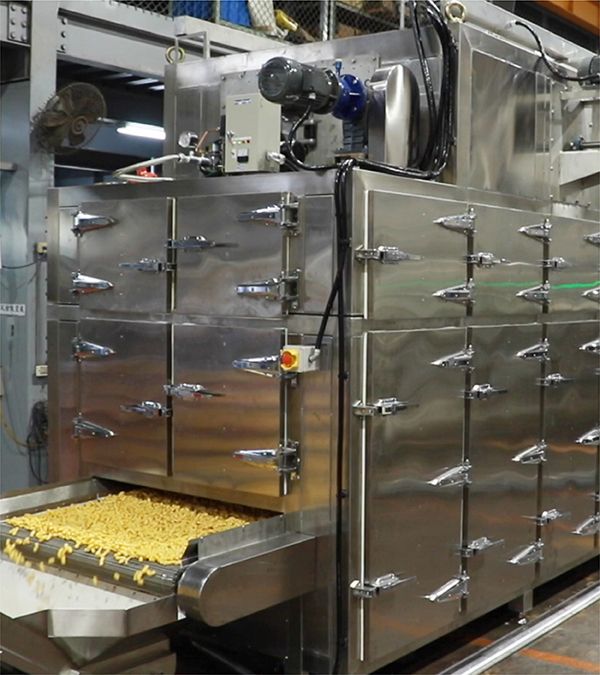
In fried The drying process is one of the key factors determining whether fried pork rinds can achieve sufficient puffing. After cooking, the moisture content of pork skin must be reduced to an appropriate level, allowing the remaining moisture to rapidly vaporize during frying and form a porous structure that creates a light and crispy texture. production, the initial cooking process is a critical stage that directly affects the quality of subsequent puffing. By maintaining stable heating temperatures and residence times, proteins and collagen structures in the pork skin can be uniformly cooked while partially removing excess fat and impurities. This prepares the pork skin for subsequent drying, frying, and puffing processes.
Insufficient cooking may reduce drying efficiency, result in incomplete puffing during frying, and produce a hard texture. Conversely, excessive cooking may weaken the pork skin structure and increase product breakage after frying. Therefore, continuous blanching equipment helps improve product consistency while minimizing quality variations caused by manual operations.
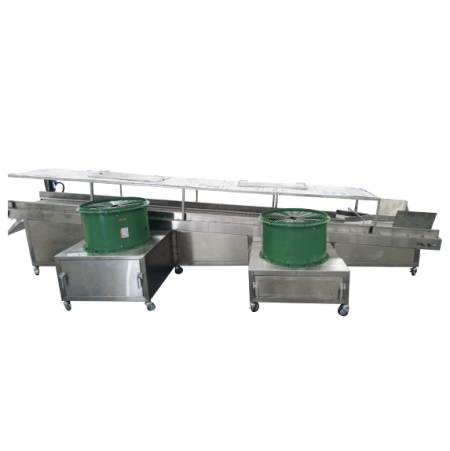
Pork Rinds Cooling Conveyor | Post-Frying Pork Rinds Cooling System
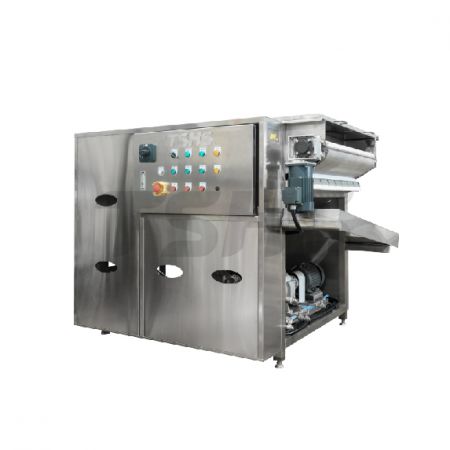
After seasoning, products must be cooled quickly to prevent residual heat from causing moisture condensation during packaging, which can negatively affect crispiness and shelf life. The Cooling Conveyor System ensures uniform heat dissipation and stabilizes product temperature before packaging, reducing the risk of moisture reabsorption. It can also be seamlessly integrated with downstream metal detection, weighing, and packaging equipment.
This equipment improves overall production line efficiency and supports continuous operation while maintaining optimal crispiness and shelf-life stability for fried pork rinds, crispy chicken skin, and other fried snack products.
The configuration, operating parameters, processing methods, and final production capacity of the automated production line should be determined based on the customer’s actual product formulation and target specifications, and verified through product testing.
Why choose the Pork Rinds frying line equipment manufactured by TSHS
With years of experience in exporting food processing equipment, Tsung Hsing (TSHS) provides integrated production solutions tailored to different product types, production capacity requirements, and factory layouts. Rather than simply supplying individual machines, TSHS helps food manufacturers establish stable and efficient fried pork rinds production systems. From initial boiling and cooking, drying, frying, and frying oil management to downstream de-oiling, seasoning, cooling, and conveying, TSHS offers comprehensive equipment integration recommendations to help manufacturers achieve automated production, reduce oil consumption and labor costs, and improve overall production line efficiency.
During the project planning stage, Tsung Hsing (TSHS) provides equipment selection recommendations, production capacity assessments, process testing, and complete production line layout planning. Based on the specific product requirements of different markets, such as the Philippines, Thailand, and the United Kingdom, TSHS helps customers develop customized fried pork rinds processing solutions that align with their target market positioning.
FAQ Summary Of Pork Rinds
Q1 What equipment is required for fried pork rinds production?
A typical fried pork rinds production line includes cooking equipment, drying equipment, a continuous fryer, an oil filtration system, de-oiling equipment, seasoning equipment, a cooling conveyor, and packaging equipment. Equipment configurations can be customized based on the characteristics of different products, such as Pork Rinds, Chicharrón, Kaeb Moo, and Pork Scratchings, as well as specific production capacity requirements.
Q2 How can fried pork rinds production efficiency be improved?
The key to improving fried pork skin production efficiency lies in maintaining stable cooking, drying, and frying conditions. By integrating a continuous frying system, automated conveying equipment, and an oil filtration system, manufacturers can reduce reliance on manual labor, extend frying oil service life, improve product consistency, and increase overall production capacity.
Q3 Which frying system is suitable for fried pork rinds production?
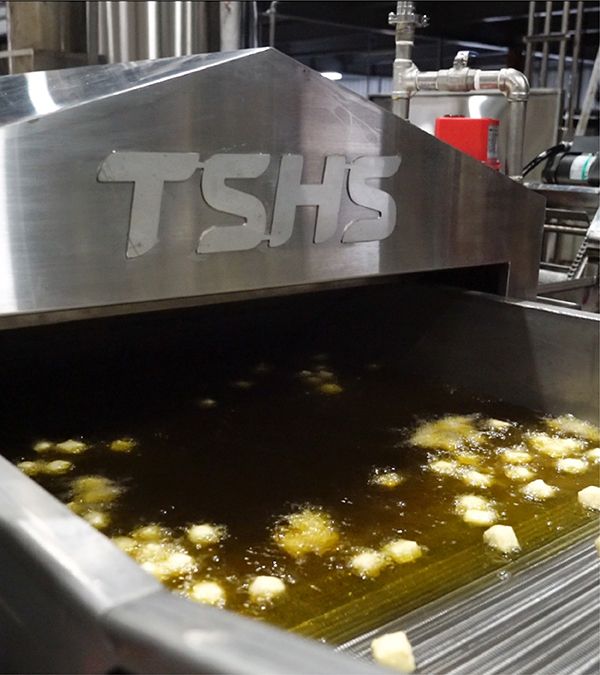
The FRYIN-K Series Continuous Fryer is suitable for producing Pork Rinds, Chicharrón, Chicharon, Kaeb Moo, Pork Scratchings, and other fried meat snacks. It provides stable frying oil temperature control, precise residence time adjustment, and uniform heat distribution, helping manufacturers achieve consistent puffing performance and crispy product texture.
Applications
 Pork Rinds Expansion|Fried Snack Processing
 Crispy Chicharrón Food|Pork Skin Cooking
 Kaeb Moo Snacks Food|Continuous Food Processing Line
- Related Products
Continuous Inner-Furnace Fryer (FRYIN-K Series)
FRYIN-302K、FRYIN-402K
The FRYIN-K Series Continuous Fryer is engineered to comply with European CE safety regulations...
Details
Continuous Fine Filter
TsungHsing Food Machinery is a Continuous Fine Filter machine manufacturer and supplier. TsungHsing...
Details
Centrifugal De-oiling Machine
TsungHsing Food Machinery is a continuous de-fatting machine manufacturer and supplier. Centrifugal...
Details
Rotary Seasoning Drum Equipment
TsungHsing Food Machinery is a rotary seasoning drum machine manufacturer and supplier. TsungHsing...
Details
FRYIN-201 Small-size Continuous Fryer
Enter the continuous production market at an affordable price. The "small volume, space-saving" FRYIN-201 fryer. Suitable for small food industry, central kitchens, restaurants, food stores, schools, etc.
 Download
Hot Products

Tags
- Pork Rinds Production Line
- Fried Pork Rinds Processing Equipment
- Pork Rinds Frying Machine
- Chicharrón Production Line
- Chicharon Processing Equipment
- Pork Scratchings Production Equipment
- Kaeb Moo Production Line
- Continuous Fryer for Pork Rinds
- Pork Skin Snack Processing Line
- Fried pork rinds Production Equipment
Over 50 Years of Fried Pork Rinds Machine And Equipment Supplier Supply | TSHS
Based in Taiwan, since 1965, TSUNG HSING FOOD MACHINERY CO., LTD. is a Fried Pork Rinds Machine And Equipment Supplier supplier in snack foods industry.
500 food processing production lines sold in 65 countries, TSHS is a food machine expert with over 60 years of experiences. CE certified, reasonably priced food processing machinery are industrial fryers, oil heating systems, seasoning tumblers, liquid mixer machines, liquid sprayer machines, etc.
TSHS has been offering customers high-quality food processing machines for green peas, nuts, potato chips, grain puffs and corn puffs, with total snack foods solutions. They represent trust, specialty, high-quality and safety specialization, which is where their name TSHS came from.
View our quality products Production Line, Continuous Automatic Fryer, Food Production Line, Continuous Fryer and feel free to Contact Us.