
What is Teflon (PTFE)? Understanding the Properties and Applications of Non-Stick Materials | TSHS News and Events | TSUNG HSING FOOD MACHINERY CO., LTD.
TSHS What is Teflon (PTFE)? Understanding the Properties and Applications of Non-Stick Materials. TSHS is a professional food machine manufacturer. We have exclusive patented heating system. Provided more than 500 frying production around the world. Also offer customized microwave industrial dryer.. We are a professional frying machine manufacturer. And provide customized continuous automatic drying equipment services. Our customer includes the top 10 snack food companies in various countries, central kitchen, other fried food manufacturers, Food Industry/Biotechnology Industry/Chemical Industry/Rubber Industry/Textile Industry. that have a need for the drying system. We have 60 years of professional food equipment manufacturing experience, specialized in food frying production equipment, customized continuous drying systems, extruder equipment, seasoning systems, de-oiling equipment. We provide global installation services, entire factory planning consultation, production knowledge guidance, improve the process problems, and provide after-services of maintaining inspection for equipment. TSHS equipment is always your best choice.
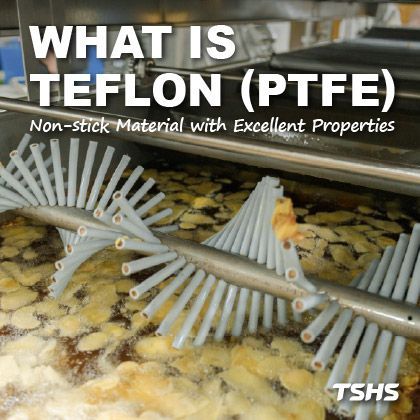
What is Teflon (PTFE)? Understanding the Properties and Applications of Non-Stick Materials
For most people, the first encounter with Teflon (PTFE) is through non-stick cookware in the kitchen. When food flips easily, doesn’t stick, and cleaning becomes effortless, we rarely realize that a high-performance engineering material is at work behind the scenes.
Teflon is not just about making cooking more convenient—it is also an essential material widely used in industries such as food processing, chemical engineering, and semiconductors. This article will guide you through the core properties of PTFE and its applications across various industries, revealing its critical role in both everyday life and industrial production.
Key Properties of Teflon (PTFE)
The formal name of Teflon is Polytetrafluoroethylene (PTFE), a type of fluoropolymer. Its molecular structure is tightly surrounded by fluorine atoms, forming a highly stable outer layer. This results in extremely low surface energy, meaning that other substances can hardly adhere to it.
PTFE has a friction coefficient of approximately 0.04–0.1, making it one of the lowest-friction solid materials known today.
This unique molecular structure gives PTFE several key material properties:
• Extremely low friction coefficient (reduces adhesion and flow resistance)
• Excellent thermal stability (maintains structural integrity under high temperatures)
• Outstanding chemical inertness (resistant to acids, alkalis, and most chemicals)

Heat Resistance and Corrosion Resistance: Why PTFE Is Widely Used in Industry
Understanding PTFE solely as a “non-stick” material does not fully capture its importance in industrial applications. Its widespread adoption as a standard engineering material lies in its ability to maintain performance under high-temperature and highly corrosive conditions.
In terms of temperature resistance, PTFE can operate continuously within a range of approximately -190°C to 260°C, making it suitable for high-temperature frying, heat processing, and continuous production systems. In chemical environments, it exhibits excellent resistance to strong acids, strong alkalis, and most solvents, effectively reducing material degradation and the risk of equipment corrosion.
Thanks to these properties, PTFE is widely used across various industries. In the chemical industry, it is commonly applied as pipe linings and sealing components to minimize corrosion and leakage risks. In the semiconductor industry, it is used in high-purity fluid transfer systems to ensure process cleanliness and stability. In the medical field, its low-friction properties make it suitable for applications such as catheters, artificial blood vessels, and surgical instruments.
When a material combines low friction, high temperature resistance, and corrosion resistance, it not only extends equipment lifespan but also reduces maintenance and downtime costs. In addition, PTFE complies with food contact material standards, making it a common choice in food processing equipment as well as a wide range of industrial systems.
Is Teflon (PTFE) Safe? It Depends on How It's Used
The safety of PTFE has long been a concern for consumers. Under normal usage conditions, PTFE is a stable and safe material, and it has been widely used in food-contact equipment. However, it is important to note that when PTFE is heated above approximately 260°C (500°F) under no-load conditions (such as an empty pan), it may begin to decompose and release fumes. Short-term inhalation of these fumes may cause flu-like symptoms. Therefore, avoiding overheating and improper use is key to ensuring safety. Overall, the safety of PTFE is not limited by the material itself, but rather by how it is used. With proper handling—avoiding excessive heat and preventing damage to the coating—it can be safely applied in both food processing and everyday cooking.
Comparison of Non-Stick Coatings: PTFE, Ceramic, and Titanium
In addition to PTFE (Teflon), common non-stick coatings on the market also include ceramic and titanium-based coatings. There is no absolute “best” option—each material should be evaluated based on application requirements, usage frequency, and maintenance conditions. In general, PTFE offers the best non-stick performance, effectively reducing food adhesion and residue, which is why it is widely used in food processing equipment and conveying systems. Ceramic coatings provide better high-temperature resistance and scratch resistance, but their non-stick performance may decline over time. Titanium-based coatings emphasize durability and thermal conductivity, making them suitable for applications requiring high strength and wear resistance.

From Kitchen to Production Line: How PTFE Impacts Food Processing
When we shift our perspective from the home kitchen to industrial food production, it becomes clear that “stickiness” is not just a cleaning issue—it directly affects product quality and production efficiency. When raw materials adhere to equipment surfaces, it can lead to inconsistent product shapes, increased material waste, and higher oil consumption. These seemingly minor issues can accumulate over time, resulting in significant operational costs.

To address this, incorporating low-adhesion materials such as PTFE coatings into food processing equipment can improve material flow throughout the production process. Whether applied to conveyor belts, rollers, or contact surfaces, PTFE helps reduce residue buildup and ensures smooth product movement. With a more streamlined process, product quality becomes easier to control, while overall hygiene standards can also be maintained more effectively.
The Importance of Material Selection in Equipment Design
In food processing and conveying systems, material selection not only affects performance but also forms the foundation of successful equipment design.
• Reduce adhesion and residue of coated or breaded materials, minimizing waste and improving efficiency.
• Enhance product consistency and maintain stable production quality.
• Lower cleaning, labor, and oil consumption costs.
With multiple international patents and extensive industry experience, we provide customized solutions tailored to different product characteristics and production requirements. Whether for small-scale processing lines or large industrial systems, our solutions help make frying and other food processing operations more efficient, safer, and easier to maintain—ultimately enhancing overall production value.
👉 Contact us today to learn how PTFE conveyor belts can improve your production efficiency!
Hot Products
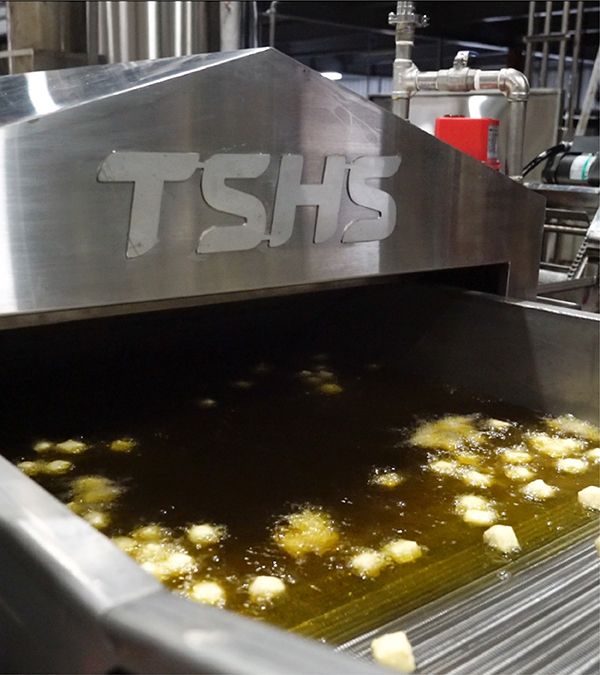
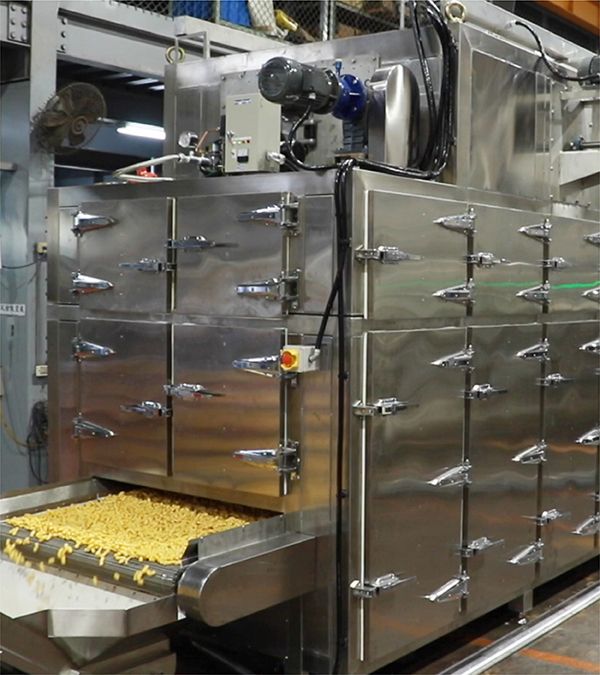
FRYIN-201 Small-size Continuous Fryer
Enter the continuous production market at an affordable price. The "small volume, space-saving" FRYIN-201 fryer. Suitable for small food industry, central kitchens, restaurants, food stores, schools, etc.
 Download
 Over 50 Years of Deep Fryer Machine | Snack Food Processing Equipment & Turnkey Project Supply | TSHS
Based in Taiwan, since 1965, TSUNG HSING FOOD MACHINERY CO., LTD. is a food processing equipment supplier in snack foods industry.
500 food processing production lines sold in 65 countries, TSHS is a food machine expert with over 60 years of experiences. CE certified, reasonably priced food processing machinery are industrial fryers, oil heating systems, seasoning tumblers, liquid mixer machines, liquid sprayer machines, etc.
TSHS has been offering customers high-quality food processing machines for green peas, nuts, potato chips, grain puffs and corn puffs, with total snack foods solutions. They represent trust, specialty, high-quality and safety specialization, which is where their name TSHS came from.