
Understanding Frying Oil Quality: Key Indicators for Effective Oil Management | TSHS News and Events | TSUNG HSING FOOD MACHINERY CO., LTD.
TSHS Understanding Frying Oil Quality: Key Indicators for Effective Oil Management. TSHS is a professional food machine manufacturer. We have exclusive patented heating system. Provided more than 500 frying production around the world. Also offer customized microwave industrial dryer.. We are a professional frying machine manufacturer. And provide customized continuous automatic drying equipment services. Our customer includes the top 10 snack food companies in various countries, central kitchen, other fried food manufacturers, Food Industry/Biotechnology Industry/Chemical Industry/Rubber Industry/Textile Industry. that have a need for the drying system. We have 60 years of professional food equipment manufacturing experience, specialized in food frying production equipment, customized continuous drying systems, extruder equipment, seasoning systems, de-oiling equipment. We provide global installation services, entire factory planning consultation, production knowledge guidance, improve the process problems, and provide after-services of maintaining inspection for equipment. TSHS equipment is always your best choice.
Understanding Frying Oil Quality: Key Indicators for Effective Oil Management
The quality of frying oil directly affects the texture, color consistency, and food safety of fried products.In modern food processing facilities, even if frying equipment operates consistently, inadequate oil management can still lead to inconsistent product quality, flavor deterioration, and potential food safety risks.
For this reason, oil quality monitoring is no longer just a supplementary task, but a critical part of managing a frying production line.
This article provides a practical overview of common indicators of oil degradation, helping food manufacturers better understand oil quality management and establish a more stable and controlled oil management system.
Why Does Frying Oil Degrade? Key Reactions in the Frying Process
Under conditions of high temperatures and repeated frying over long periods, cooking oils undergo continuous oxidation, hydrolysis, and polymerization reactions. These chemical reactions gradually alter the structure of the oil, causing degradation by-products to accumulate and the overall oil quality to decline. As frying time increases, the oil often shows signs such as rising free fatty acid levels, increased oxidation and polymer compounds, darker color, and a lower smoke point, sometimes accompanied by rancid or irritating odors. When these changes appear, it usually indicates that the oil has entered a clear stage of deterioration. Oil degradation not only affects the crispness and flavor stability of fried foods, but can also increase oil absorption, resulting in a greasy texture. Therefore, in modern frying production lines, the food industry typically relies on multiple indicators to evaluate oil quality and maintain consistent product standards.

Overview of Common Indicators for Frying Oil Degradation
Determining whether frying oil should be replaced cannot rely solely on experience; it must be evaluated through measurable data. Each indicator reflects a different aspect of oil degradation, and in practice they are usually used together rather than as a single decision metric. In the food industry, the most commonly used indicators for monitoring oil quality include:
• TPC (Total Polar Compounds): Indicates the overall aging level of the oil
• AV (Acid Value): Reflects the level of free fatty acids in the oil
• POV (Peroxide Value): Shows the early stage of oil oxidation
• Color: Indicates quality changes caused by repeated heating
1. TPC (Total Polar Compounds): A Key Indicator for Oil Replacement
TPC is one of the most widely used indicators in the global food industry for determining when frying oil should be replaced. When oil is exposed to high temperatures and oxygen, it produces polar substances such as free fatty acids, oxidation products, and polymers. These compounds accumulate over time and cannot revert to their original oil structure.
Generally, TPC levels below 20% indicate good oil condition, while 25% is commonly regarded as the upper safety limit for frying oil. When this threshold is exceeded, both product quality and food safety risks increase significantly.
2. Acid Value (AV): Reflecting Oil Hydrolysis and Usage Time
Acid value represents the amount of potassium hydroxide (KOH) in milligrams required to neutralize the free fatty acids in one gram of oil. During repeated heating, oil gradually undergoes hydrolysis, releasing free fatty acids and causing the acid value to increase. Therefore, AV is widely used as an important indicator of oil deterioration.
In many large food factories, the oil replacement standard is typically set at AV below 0.5, while regulations often specify that frying oil should not exceed an AV of 2.0. When the acid value becomes too high, the oil’s smoke point decreases, which can cause excessive smoke during frying and produce a sharp rancid odor, negatively affecting both product quality and the working environment of the production line.
3. Peroxide Value (POV): Detecting Early Oxidation of Oil
Peroxide value measures the amount of peroxides present in oil, making it an indicator of the early stage of oxidation. An increase in POV indicates that oxidation is occurring. However, once oxidation progresses further, peroxides begin to decompose, which can cause the POV value to decrease. For this reason, POV is not suitable as the sole indicator for evaluating oil used over long frying periods.
For freshly refined oil, the POV is usually controlled below 1 at the time of production. When POV becomes too high, the oil typically develops a noticeable rancid odor.
4. Color: The Most Intuitive but Not a Standalone Indicator
Darkening oil color is usually related to excessive frying temperatures, carbonization of food residues, or insufficient oil stability. In industrial practice, color is commonly measured using a Lovibond Tintometer, which records red (R) and yellow (Y) values.
An increase in the Y value usually indicates natural color darkening due to heating, while a noticeable increase in the R value is often associated with oxidation, polymerization, and carbonized by-products.
Fresh oil typically produces fried products with a uniform golden color. If the color becomes abnormal, it may signal declining oil quality. However, color alone should not be used as the sole basis for determining oil replacement, and should be evaluated together with other indicators.
How to Test Cooking Oil On-Site: Quick Methods to Identify Oil Degradation
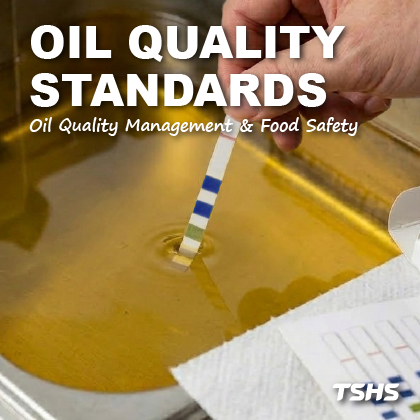
In addition to laboratory analysis and professional instruments, food factories and food service operators can also use oil degradation test strips or cooking oil testing devices for quick on-site evaluations as part of their daily oil management routine. These tools are particularly suitable for routine inspections on frying production lines, allowing operators to monitor oil conditions in real time without interrupting production. Oil degradation test strips mainly determine oil quality based on changes in the acid value (AV). In practice, the test is simple: the strip is dipped into the hot frying oil for a few seconds and then removed. After a short waiting period, the color change on the indicator strip can be observed. The test is typically performed when the oil temperature is between 163°C and 204°C. As the acid value increases, the color indicator gradually changes from blue to yellow. When the color reaches or exceeds the warning level—usually indicated by a visible yellow shift or crossing the marked threshold—it signals that the oil has approached or reached its degradation limit and should be replaced to avoid affecting product quality and food safety. Although test strips are fast and easy to use, it is still recommended to combine their results with TPC measurements or other oil degradation indicators. Using multiple indicators together helps establish a more comprehensive and stable oil quality management system.

Oil Management Is Not Just Testing—It Is Part of Overall Process Design
By regularly monitoring indicators such as Acid Value (AV), Peroxide Value (POV), and Total Polar Compounds (TPC), companies can shift production line management from traditional experience-based decisions to a data-driven management approach that is traceable and analyzable. This allows businesses to achieve a more precise balance between product quality stability and cost control. However, truly effective oil quality management cannot rely solely on a single indicator or testing frequency. It must be planned together with the overall production process design. Key factors include a stable oil temperature control system, well-designed frying equipment structure, efficient oil circulation and filtration mechanisms, and clear, actionable oil replacement criteria. These elements are essential for extending oil lifespan and reducing the rate of oil degradation.

Improving Equipment Design to Extend Oil Life and Reduce Oil and Energy Costs
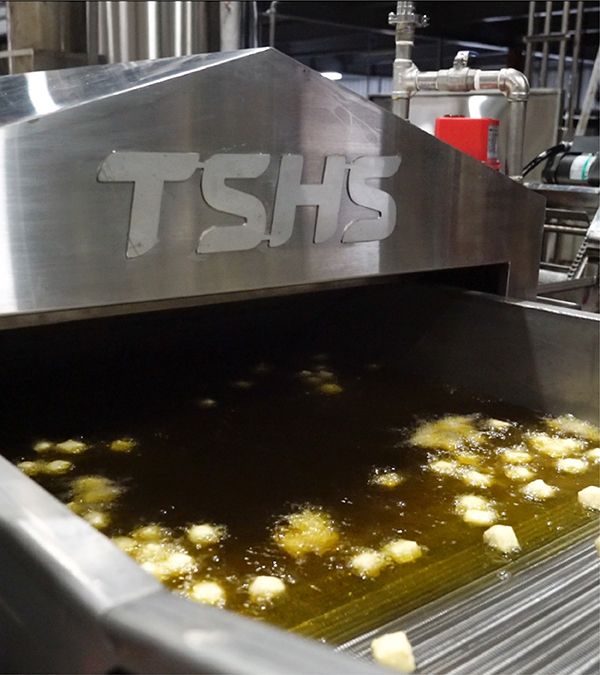
In real frying production lines, the design details of frying equipment often have a direct impact on the rate of oil degradation and overall operating costs. At TSHS, the frying equipment is designed with oil pipes integrated inside the machine body rather than exposed externally. This design effectively shortens the oil pipeline length, reducing unnecessary oil retention and saving approximately 20% of the total oil capacity, achieving a true oil-saving effect. In addition, the shorter oil piping also reduces the head pressure required by the oil circulation pump. A lower head pressure means the pump operates under less load, which can further reduce energy consumption by about 40%.
Combined with a stable oil circulation pump system, heat distribution within the oil becomes more uniform, reducing localized overheating and helping extend the lifespan of frying oil while lowering the frequency of oil replacement. By selecting the right frying equipment and production line design, food manufacturers can achieve better process control while balancing oil savings, energy efficiency, and longer oil usage cycles.
Hot Products
FRYIN-201 Small-size Continuous Fryer
Enter the continuous production market at an affordable price. The "small volume, space-saving" FRYIN-201 fryer. Suitable for small food industry, central kitchens, restaurants, food stores, schools, etc.
 Download
 Over 50 Years of Deep Fryer Machine | Snack Food Processing Equipment & Turnkey Project Supply | TSHS
Based in Taiwan, since 1965, TSUNG HSING FOOD MACHINERY CO., LTD. is a food processing equipment supplier in snack foods industry.
500 food processing production lines sold in 65 countries, TSHS is a food machine expert with over 60 years of experiences. CE certified, reasonably priced food processing machinery are industrial fryers, oil heating systems, seasoning tumblers, liquid mixer machines, liquid sprayer machines, etc.
TSHS has been offering customers high-quality food processing machines for green peas, nuts, potato chips, grain puffs and corn puffs, with total snack foods solutions. They represent trust, specialty, high-quality and safety specialization, which is where their name TSHS came from.